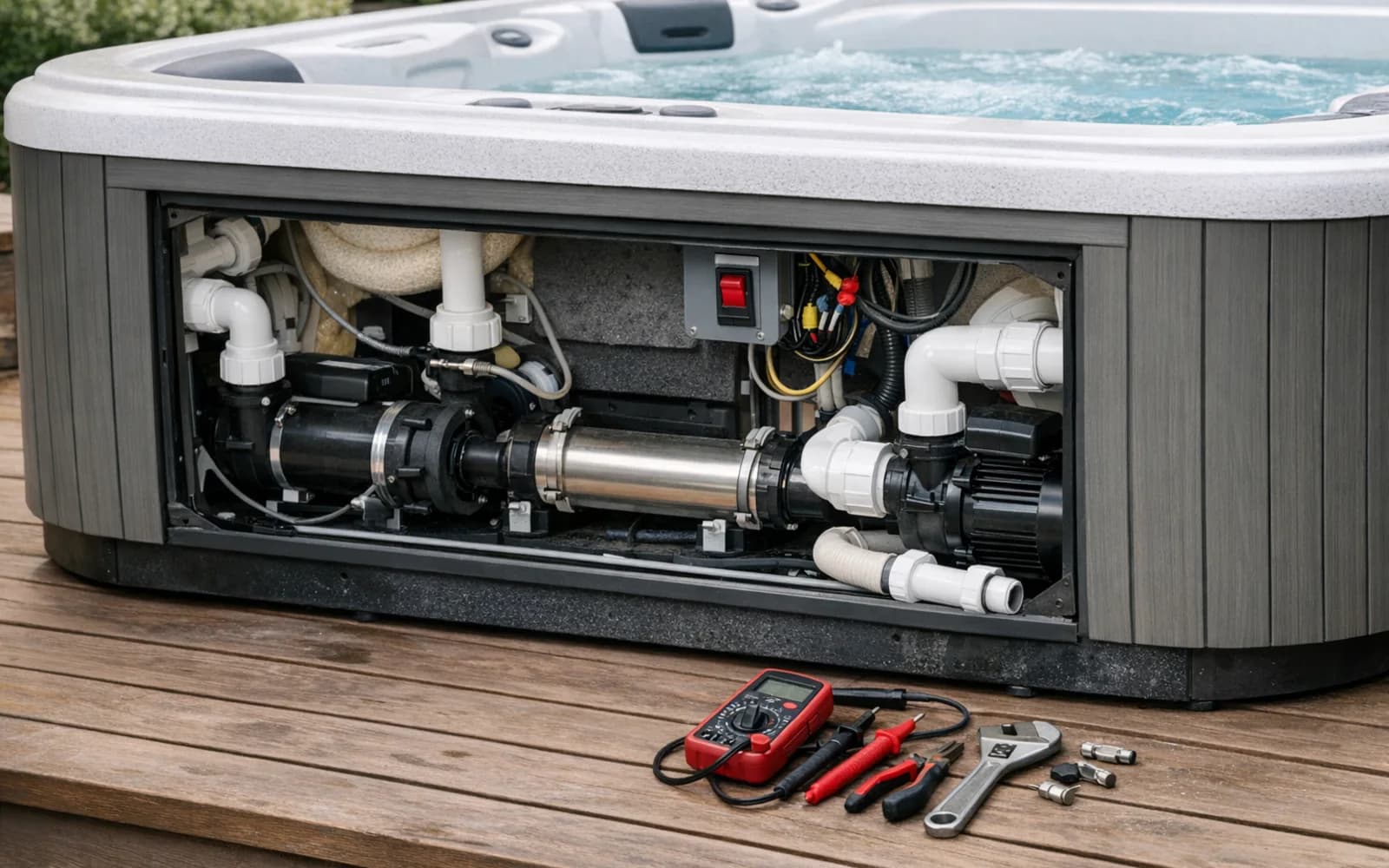
Troubleshoot hot tub FLO flow errors, no heat, cloudy or foamy water, GFCI tripping, and a pump that will not prime, plus how to reset the spa pack safely.
Power & Site
Quick answer: Most hot tub faults trace to flow, water chemistry, or power. A flow or FLO code usually means a dirty filter, low water, or trapped air, not a broken heater. Before you call for service, check the filter, water level, and GFCI, then power-cycle the spa pack at the breaker for 30 seconds.
Best for
Owners facing an error code, cold water, or a tripping breaker who want to check the cheap causes first.
Wrong fit
A wiring, ground-fault, or gas diagnosis that needs a licensed pro.
Tradeoff
Ten minutes of basic checks usually beats a service call, but stop at anything electrical.
The short answer: Most hot tub faults trace to flow, water chemistry, or power. A flow or FLO code usually means a dirty filter, low water, or trapped air, not a broken heater. Before you call for service, check the filter, water level, and GFCI, then power-cycle the spa pack at the breaker for 30 seconds.
This guide walks the common symptoms in order of likelihood, keeps error codes generic across brands, and tells you where the do-it-yourself line stops and a licensed pro begins.
Decision point
Practical answer
Best first check
Filter, water level, and GFCI, then a 30-second reset.
Who it is for
Owners facing an error code, cold water, or a tripping breaker.
Who should slow down
Anyone chasing a wiring, ground-fault, or gas issue.
Main tradeoff
Basic checks usually beat a service call, but stop at anything electrical.
Symptom, Cause, and First Fix
Work top to bottom. Most cold-water and error-code calls are solved by the cheap causes in this table before a part is ever replaced.
Symptom or error
Likely cause
First fix
FLO / FL / flow error
Dirty filter, low water, closed valve, trapped air, or a weak circulation pump
Clean or soak the filter, top up water, open all valves, and purge air by briefly loosening a pump union
Not heating (water cold)
Flow fault, tripped high-limit, low water, economy mode, or a failed heater element
Confirm the set temperature and standard mode, clear any flow issue, check the GFCI, then have the heater tested
Cloudy or foamy water
Low sanitizer, high pH or alkalinity, body oils and lotions, old water, or a worn filter
Test and balance, sanitize or shock, rinse the filter, and drain and refill if the water is old
GFCI or breaker tripping
Moisture in a connection, a grounding heater element, damaged wiring, or a faulty GFCI
Reset once. If it trips again, stop and call a licensed electrician or service tech
Pump not priming (air, no jets)
Airlock after a refill, low water, a closed valve, or a clogged filter
Open the air controls, top up water, and bleed the pump union until water burbles, then retighten
Dead or frozen topside panel
Power interruption, tripped breaker, or a control fault
Power-cycle at the breaker for 30 seconds, then check the breaker and GFCI
The buyer move is simple: change one thing at a time and recheck. Use the filter-cleaner guide when a rinse does not restore flow, the test-kit guide before guessing at chemistry, and a spa vacuum only for debris that has actually settled on the floor.
How to Power-Cycle the Spa Pack Safely
A reset clears many nuisance faults, but it is not a repair. Do it with power off, never with the equipment door open and energized:
Turn off the dedicated breaker for the tub. For a 110V plug-and-play model, unplug it at the GFCI cord instead.
Wait 30 to 60 seconds so the controller fully powers down.
Restore power and watch the topside panel reboot.
Give the tub a few minutes to re-prime and show an accurate temperature before you judge whether the fault cleared.
Never open the spa pack or touch wiring with power on. Water and electricity are the reason hot tubs are wired to a ground-fault device in the first place.
Reading Error Codes Across Brands
Most tubs run a Balboa or Gecko control system, so codes rhyme even when the letters differ. Treat these as categories and confirm the exact meaning in your manual:
FLO, FL, or a flashing flow icon: flow. Not enough water is moving past the heater.
OH, HH, or HL: overheat or high-limit. The pack shut the heater down for safety.
SN, Sn, or a sensor code: a temperature sensor fault.
DR or DY: dry or low water detected by the flow switch.
ICE or a snowflake: freeze protection running the pumps to prevent damage.
A code is a starting point, not a diagnosis. Two tubs can throw the same flow code for a dirty filter or a failing pump.
When to Call a Pro
Handle filters, water level, chemistry, and a single reset yourself. Bring in a licensed electrician or service tech when:
The GFCI trips again right after you reset it.
You smell burning, see scorched connectors, or the heater never warms after flow is confirmed good.
A sensor or wiring code returns after a clean filter and a reset.
The tub is hardwired and the fault points at the breaker, subpanel, or bonding.
It signals a flow problem: the controller cannot confirm enough water is moving past the heater. The usual causes are a dirty filter, low water, a closed valve, or trapped air, not a failed part.
Why is my hot tub not heating?
Common causes are a flow fault, a tripped high-limit, low water, the tub sitting in economy mode, or a failed heater element. Clear any flow issue and confirm the set temperature and standard mode first, then have the heater checked.
How do I reset my hot tub?
Turn off the dedicated breaker (or unplug a 110V tub), wait 30 to 60 seconds, then restore power and let the panel reboot. A reset clears many nuisance faults but will not fix a real flow, sensor, or wiring problem.
My GFCI keeps tripping. What should I do?
Reset it once. If it trips again, stop. A repeat trip usually means a ground fault, often a failing heater element or moisture in a connection, and that is an electrician or service call, not a do-it-yourself fix.
These guides are built from manufacturer documentation, public specifications, primary research where health claims matter, and repeated buyer questions that show up in real ownership and installation decisions.
Manufacturer and dealer sources can clarify pricing bands, warranty terms, support footprint, or common mistakes. They do not move a page up the shortlist on their own.