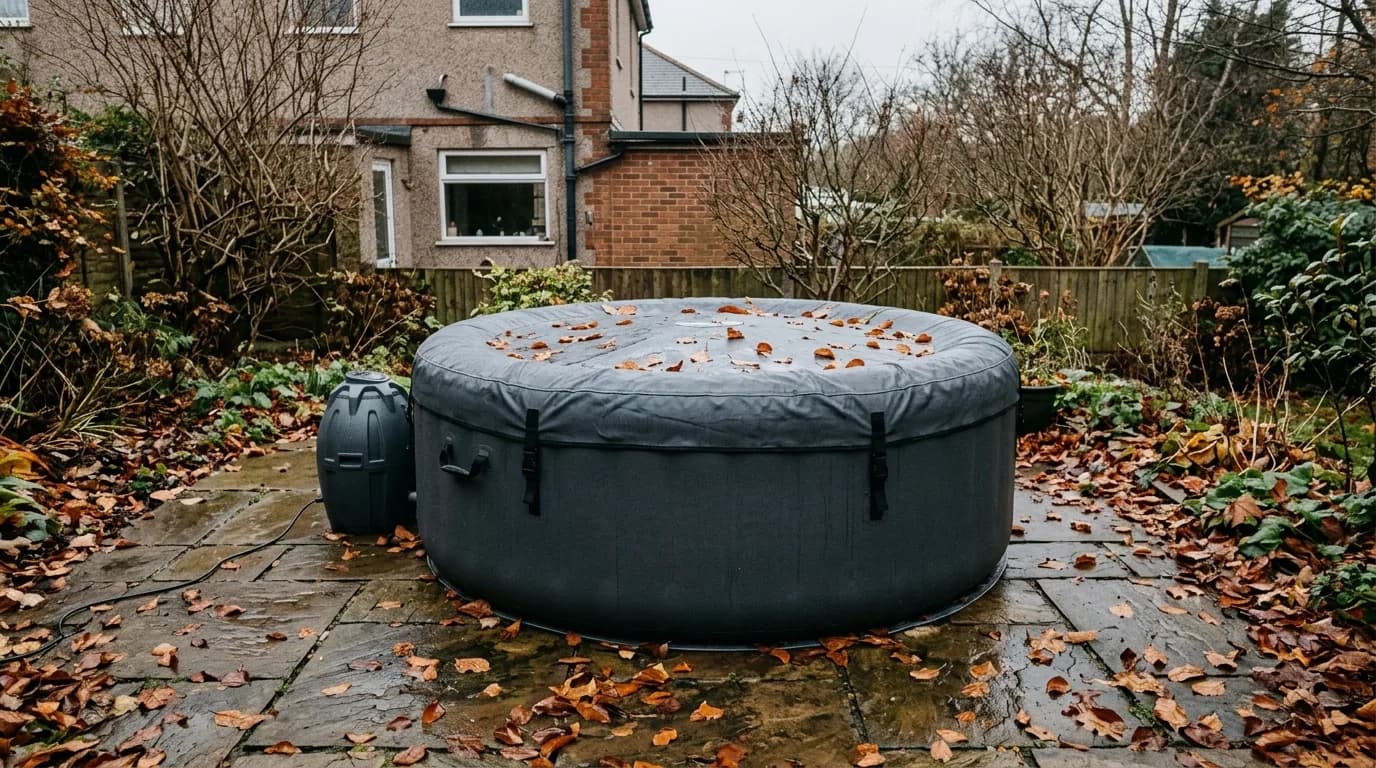
Inflatable Hot Tubs 2026: What $400 Actually Buys

Hot Tubs Guide

By Hot Tubs Guide Editorial Team

Inflatable Hot Tubs 2026: What $400 Actually Buys

Inflatable hot tubs cost $280 to $600 and run $45 to $85 a month. They take 12 to 24 hours to heat and most last 2 to 3 years. Here is the honest maths.

Quick answer: An inflatable hot tub costs about $280 to $600 to buy and $45 to $85 a month to run, roughly $45 in summer and $85 in winter. It takes 12 to 24 hours to heat from cold, rising 1 to 3°F per hour, and most last 2 to 3 years with the pump and heater usually failing first around 18 months. That makes it a genuine answer for trying the habit, a poor one for keeping it. Over five years the running cost alone passes the purchase price several times over.

Best for

Anyone deciding whether to spend a few hundred dollars on an inflatable tub, and anyone wondering whether it is a stepping stone to a real one.

Wrong fit

Buyers holding a dealer quote for an acrylic spa. This is a different purchase with different maths, and our quote review covers that one.

Tradeoff

The lowest possible entry price, paid back in slow heating, high running cost per hour of use, and a service life measured in a few years rather than a decade.

An inflatable hot tub is the cheapest way to find out whether you actually want a hot tub. That is a real thing to want, and this page exists because a lot of people arrive here asking about them and get pushed toward a $15,000 acrylic spa instead.

We do not sell hot tubs. Our main work is reading dealer quotes, where the numbers run into five figures and the mistakes are expensive. An inflatable tub does not come with a quote. But it does come with running costs that nobody puts on the box, and those are worth knowing before you buy.

The numbers

Typical
Purchase priceabout $280 to $600
Running cost$45 to $85 a month, around $45 summer and $85 winter
Time to heat from cold12 to 24 hours, rising 1 to 3°F per hour
Heater drawabout 1,500 watts, cycling 30 to 60 minutes an hour
Typical service life2 to 3 years, pump and heater often first at around 18 months

Checked August 2026. Prices move a lot with the season and with sales.

The number that surprises people is not the price. It is that the running cost over two years comfortably exceeds what the tub cost, and that the machine most likely to fail is the one you cannot easily replace.

The heating problem is the real one

A 1,500 watt heater in a vinyl shell with a thin cover is not much heat against a lot of water. From a cold fill you are looking at overnight at minimum, and often a full day.

That changes how you use it. A rigid spa sits at temperature and you get in when you feel like it. An inflatable one, if you let it cool between uses to save electricity, needs planning a day ahead. If you keep it hot so it is ready, you are paying the winter running cost every month whether you use it twice or twenty times.

Most people discover this in month two and settle into one of those two patterns. Both are fine. Neither is the picture on the box.

Keeping the cover on saves roughly 20 percent of the electricity, which is the single highest-value habit in inflatable tub ownership.

Winter is where they get expensive

Energy use roughly doubles in winter. Owners report the better-built models holding temperature down to around 20°F with freeze protection and an insulated cover, but holding it and holding it cheaply are different things.

If you live somewhere with a real winter and you want to use a tub in January, an inflatable is the most expensive way to do it per hour of soaking. That is the point where the rigid plug-and-play lane, roughly $2,500 to $9,000, starts to look like the cheaper option rather than the pricier one.

What lasts and what does not

The shells are better than their reputation. Multi-layer reinforced PVC with an internal mesh core is genuinely rigid and stands up to a few seasons.

The pump and heater unit is the weak point, and it commonly goes at around the 18 month mark. Two to three years is the realistic life of the whole package, and up to five with careful water chemistry and winter care.

Before you buy, find out what a replacement pump unit costs and whether the manufacturer sells one separately. On some models it is a reasonable part. On others the answer is a new tub.

Which brands people buy

Coleman's SaluSpa line and Intex's PureSpa line are the two names that dominate the category, and they split fairly cleanly. Coleman tends to win on shell construction and jet performance. Intex tends to win on value and on accessories included in the box, and some models add water treatment features.

Neither appears on our brand pages, and that is deliberate. Those pages are built for buyers holding a dealer quote for a spa that will be in the garden for fifteen years, where the questions are electrical scope, delivery, crane access and labour warranty. An inflatable tub arrives in a box from a retailer. It is a purchase, not a project.

Is it a stepping stone?

Sometimes, honestly, yes. A few hundred dollars to find out whether your household actually uses a hot tub is cheap information compared with discovering it after a $15,000 install.

But be clear about what it tests. It tells you whether you like sitting in hot water in your own garden, whether your household uses it, and whether the maintenance routine is something you will keep up. It does not tell you much about seats, jets, or what a rigid spa feels like, because those are not comparable.

If the answer comes back yes and you start looking at a real spa, the questions change completely. That is when the electrical work, the pad, the delivery access and what the dealer left out of the quote start to matter, and that is the part where we can actually help.

Methodology

These guides are built from manufacturer documentation, public specifications, primary research where health claims matter, and repeated buyer questions that show up in real ownership and installation decisions.

Manufacturer and dealer sources can clarify pricing bands, warranty terms, support footprint, or common mistakes. They do not move a page up the shortlist on their own.

Written by Hot Tubs Guide Editorial TeamReviewed by Hot Tubs Guide Editorial Team, Independent hot tub buyer research on August 17, 2026How we reviewEditorial policy

Related Guides