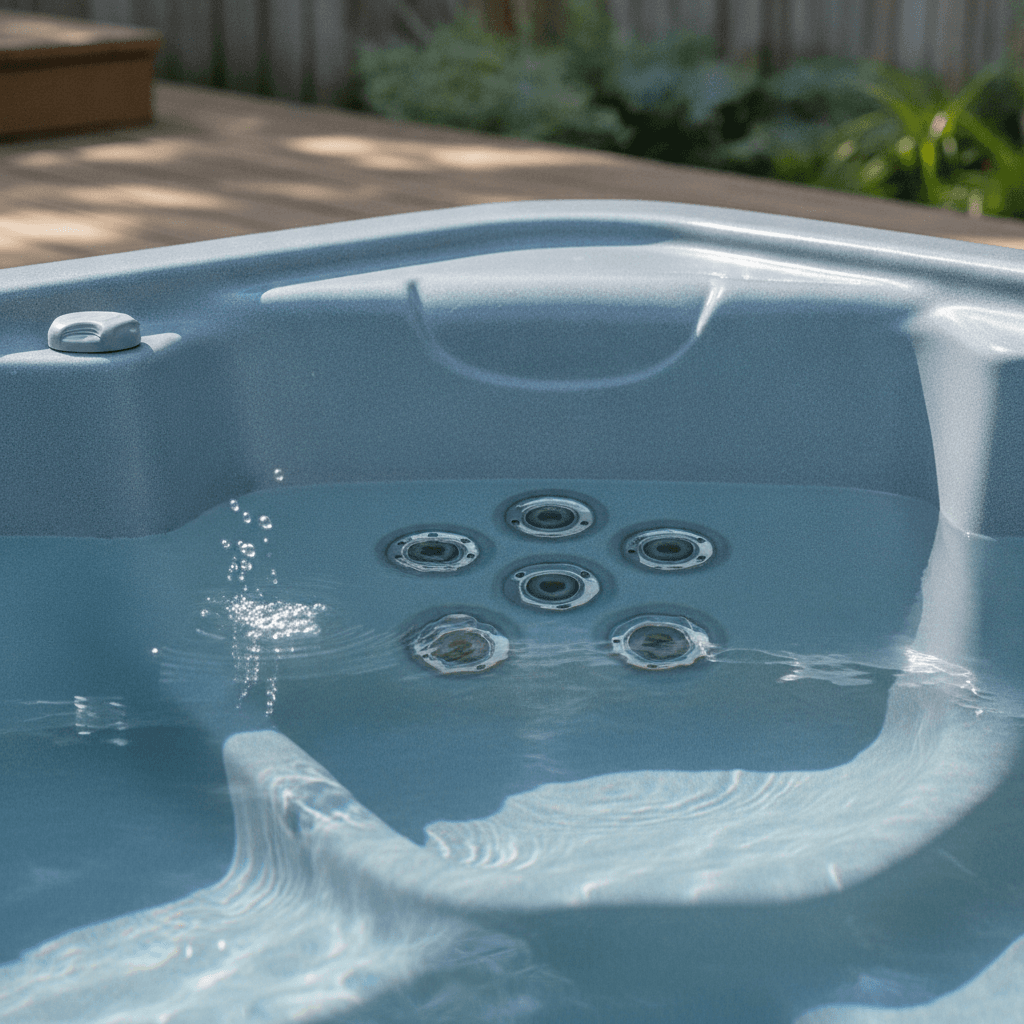
Jets per pump, jets per seat, and why a dealer's high jet count can be showroom theater rather than a reason to pay more.
Shortlist
Quick answer: Look at jets per pump (20-30 is the workable range) and jets per seat (5-6 minimum), not the total on the spec sheet. A dealer or listing that leads with a big total number is often counting weak air jets alongside real pump-driven ones.
Best for
Buyers comparing a dealer's jet count pitch, or an inflatable or plug-and-play listing's headline number, against what it actually costs.
Wrong fit
Buyers who have already wet-tested the exact model and are happy with how the jets feel on their own body.
Tradeoff
A higher total often means more pumps and higher electricity draw, not a better massage, if the ratio per pump is already thin.
The short answer: Look at jets per pump (20-30 is the workable range) and jets per seat (5-6 minimum), not the total on the spec sheet. A dealer or listing that leads with a big total number is often counting weak air jets alongside real pump-driven ones.
This guide is written for buyers who want the real ownership picture before they pay a deposit. Jet count is one of the easiest numbers for a dealer or a big-box listing to inflate, because a bigger total sounds like a better massage, and almost nobody explains the ratio that actually drives it.
Decision point
Practical answer
Best first question
How many pumps drive these jets, and how many jets sit in the seat I will actually use?
Who it is for
Buyers comparing a dealer's jet count pitch, or an inflatable or plug-and-play listing's headline number, against what it actually costs.
Who should slow down
Buyers who have already wet-tested the exact model and are happy with it.
Main tradeoff
A higher total often means more pumps and higher electricity draw, not a better massage.
The Ratio That Actually Matters
Every dealer source that publishes real numbers converges on the same range: roughly 20 to 30 jets per massage pump, and a minimum of 5 to 6 jets in the seat you will actually sit in. Above about 30 jets on one pump, water pressure gets split so many ways that individual jets weaken, even though the spec sheet total keeps climbing.
Master Spas is one of the few brands that shows its own math. Its Michael Phelps LSX 900 lists 72 jets across 3 pumps, a 24:1 ratio. Its Twilight TS 8.2 lists 44 jets across 2 pumps, a 22:1 ratio. Both land inside the same range independent dealers recommend, which is a useful sanity check: ask for the pump count, not just the jet count, and do the division yourself before you compare two quotes.
Not All "Jets" Are the Same Jet
Manufacturers use different jet styles for different jobs, and the style matters more than the count. Marquis, in its own buyer guide, groups its jets by massage type: spinning jets for a kneading effect, straight or directional jets for a focused column of water, conal or multi-port jets that disperse water for a gentler feel, and extra-high-flow jets for stronger pressure up close. Marquis states plainly that "jet count is only one part of the equation." Independent dealer sources describe a similar split into rotating, pulsating, and massaging jet types, and note that placement following the body's actual curves matters more than whether the jets sit in a straight line or a diamond pattern.
One dealer also flags a real physical tradeoff at the high end: pack too many strong jets into one seat and a smaller bather can feel pushed around the tub rather than massaged by it. More jets in one spot is not automatically a better experience, even before cost enters the picture.
Jet mechanism matters as much as count or style. Bullfrog vs Sundance is the clearest real-world example on the market: Bullfrog's A Series and up use owner-swappable JetPaks you can move between seats without a plumber, while Sundance's fixed Fluidix jets are set at the factory with no moving parts to wear out. Neither approach is a higher jet count, but the difference changes what you can do with the tub five years after you buy it.
Where the Number Gets Inflated
The clearest example of jet-count inflation sits in the budget and inflatable lane, not the dealer showroom. Intex's own product page for its PureSpa Jet and Bubble Deluxe advertises "140 soothing bubble jets and 4 high-performing massage jets," a combined headline count of 144. Only 4 of those are the kind of individually plumbed jet a dealer tub uses. The other 140 are low-pressure bubble ports fed by a single air blower, the same technology as a bubble-jet bathtub insert, not 140 separate massage points.
That does not make the tub bad for what it is. It means the "144 jets" on the box and the "72 jets" on a Michael Phelps dealer model are not the same kind of number, and a buyer comparing listings across lanes needs to ask which type of jet is being counted before treating either total as a quality signal. A modest, honestly labeled count is not a downgrade: AquaRest markets its AR600 plug-and-play model as a 29-jet tub, well inside the workable per-pump range, at a fraction of a dealer tub's price.
How Dealers Use the Number
A jet count is an easy upsell line because it is a single figure a salesperson can point to on a comparison sheet without explaining pump count, jet style, or seat placement. When a quote leans on total jet count to justify a price gap between two models, treat it the same way this site treats other dealer negotiation tactics: ask for the number behind the number. Get the pump count, the jets per seat you will use, and the jet style in writing, the same way the hot tub buying guide recommends settling use case, power, and total installed cost before you compare jet counts at all.
Quote Questions
Before you let a jet count move a decision, get these answers in writing:
How many pumps drive this jet count, and what is the resulting jets-per-pump ratio?
How many jets are in the specific seat or seats you will use most?
Are any of these jets air or bubble jets on a blower, rather than water jets on a dedicated pump?
Does a lower-jet-count model in the same brand shortlist cost meaningfully less for a comparable seat count and pump layout?
Not by itself. Past roughly 30 jets on a single pump, water pressure gets divided so many ways that individual jets weaken, even as the total on the spec sheet keeps rising.
What is a good jet-to-pump ratio?
Roughly 20 to 30 jets per massage pump, based on the range that independent dealer sources and manufacturer examples both converge on. Ask for the pump count and divide it yourself rather than trusting the total alone.
Are air jets and water jets counted the same way?
Not functionally, even when a listing counts them together. Intex's own Jet and Bubble Deluxe model is marketed as 140 bubble jets (air, single blower) plus 4 massage jets (individually plumbed). Ask which type you are getting before comparing totals across brands or lanes.
Is a low jet count, like 29 jets, a bad sign?
Not necessarily. AquaRest's AR600 plug-and-play model markets 29 jets, which is a workable ratio for its size and pump count, at a much lower price than a dealer tub advertising a higher total.
These guides are built from manufacturer documentation, public specifications, primary research where health claims matter, and repeated buyer questions that show up in real ownership and installation decisions.
Manufacturer and dealer sources can clarify pricing bands, warranty terms, support footprint, or common mistakes. They do not move a page up the shortlist on their own.
Written by Hot Tubs Guide Editorial TeamReviewed by Hot Tubs Guide Editorial Team, Independent hot tub buyer research on August 13, 2026How we reviewEditorial policy
Next Step
What to do next
Use one of these three paths. They are here to move the decision forward, not add more noise.